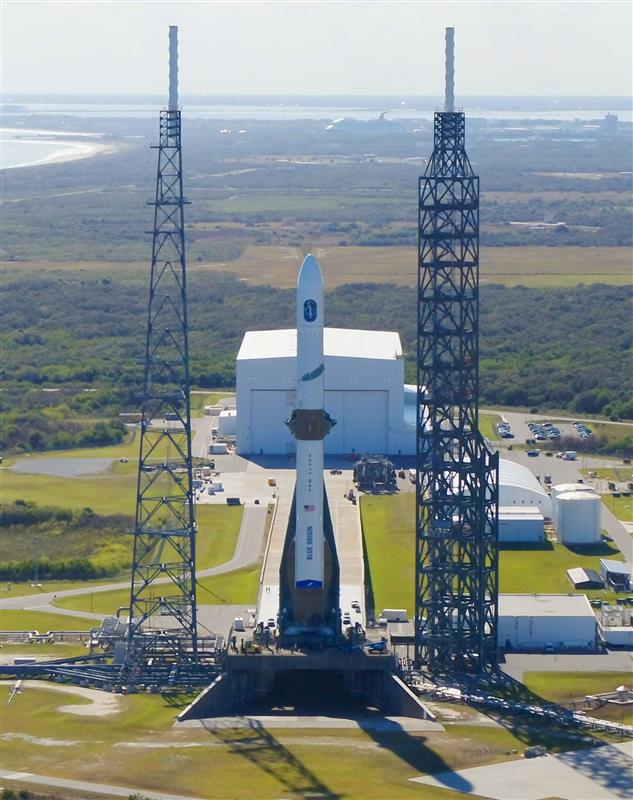
Blue Origin Cape Canaveral explosion-A powerful explosion involving Blue Origin’s New Glenn rocket at Cape Canaveral Space Force Station in Florida produced pressure waves detected as far as 1,700 kilometers away, according to a newly published scientific study.
The explosion occurred during a static-fire test at Launch Complex 36 on May 28, 2026. No injuries or fatalities were reported, but the blast created a large fireball, damaged critical launch-pad equipment and sent shock waves through surrounding Space Coast communities.
Researchers at Sandia National Laboratories have now used infrasound recordings to estimate that the explosion produced a yield of approximately 0.131 kilotons of TNT.
The peer-reviewed findings provide scientists with a rare opportunity to study a large, real-world explosion involving liquid methane and liquid oxygen, the propellant combination increasingly used by modern heavy-lift rockets.
What Happened at Blue Origin’s Cape Canaveral Launch Pad?
Blue Origin was conducting an integrated New Glenn launch-vehicle hot-fire test at Launch Complex 36 when the anomaly occurred.
A static-fire test involves igniting a rocket’s engines while the vehicle remains secured to the ground. Engineers use the procedure to evaluate engines, fuel systems, launch infrastructure and other components before flight.
During the May test, the vehicle experienced what Blue Origin initially described as an anomaly. The event rapidly escalated into an explosion and fireball visible from surrounding areas.
Nearby residents reported hearing the blast and feeling their homes shake.
Space Launch Delta 45 confirmed that all personnel had been accounted for and that nobody was injured or killed. Officials established safety procedures while Blue Origin and its partners began evaluating debris and available test data.
The Space Force subsequently described the event as the largest explosion documented on Florida’s Space Coast.
Scientists Measure the Explosion Using Infrasound
Researchers Elizabeth Silber and Logan Scamfer of Sandia National Laboratories studied low-frequency atmospheric sound waves produced by the explosion.
These waves, known as infrasound, occur below the normal frequency range of human hearing. People may not hear them directly, but specialized instruments called microbarometers can detect the small pressure changes they create.
The scientists analyzed recordings from 36 regional monitoring stations. Some instruments were located as far as 1,700 kilometers, or approximately 1,056 miles, from Cape Canaveral.
By tracing the signals backward, the researchers independently confirmed both the location and timing of the explosion.
They estimated its yield at 0.131 kilotons of TNT equivalent. That equals approximately 131 tons of TNT, although comparing a rocket-propellant accident with conventional explosives is an estimate rather than a perfect one-to-one measurement.
The research was published in The Seismic Record under the title “Infrasound Detection, Geolocation, and Yield Estimate of the May 2026 Blue Origin New Glenn Static-Fire Explosion.”
Why the Study Is Important
Full-scale accidents involving liquid methane and liquid oxygen are relatively uncommon, leaving researchers with limited observational data.
Much of the existing scientific information comes from smaller controlled experiments or historical accidents involving different types of propellant.
New Glenn uses seven BE-4 engines on its first stage. These engines burn liquefied natural gas, primarily methane, with liquid oxygen.
Other emerging launch systems also use methane-based propulsion. Understanding how those propellants behave during a major accident could help engineers design safer launch facilities, improve emergency planning and develop better methods for monitoring future incidents.
Infrasound can travel over enormous distances through the atmosphere. It is already used to examine volcanic eruptions, meteors, industrial explosions and other energetic events.
The Comprehensive Nuclear-Test-Ban Treaty Organization also incorporates infrasound into its international monitoring system for detecting possible nuclear explosions.
The Cape Canaveral event demonstrates that similar technology can provide independent information about commercial rocket accidents.
How Much Fuel Was Aboard New Glenn?
Blue Origin has not publicly disclosed exactly how much propellant was aboard the vehicle when the explosion occurred.
Because of that uncertainty, the researchers evaluated different possible fuel-loading scenarios.
Under an assumed full-fill scenario, they estimated that approximately 3 to 4 percent of the available chemical energy was converted into the rapid pressure-producing explosion. If the tanks were only half full, the proportion may have been closer to 6 percent.
Not all rocket propellant necessarily mixes and reacts simultaneously during an accident. Some of it may contribute to the initial pressure wave, while another portion burns more gradually in the resulting fireball and plume.
The estimated yield therefore represents the explosive pressure-producing part of the event rather than every form of energy released.
What Caused the Blue Origin Explosion?
Blue Origin’s investigation traced the anomaly to the main oxygen valve on one of the rocket’s BE-4 engines.
The company said recovered hardware and inspections helped confirm the origin of the problem. Engineers subsequently conducted component-level examinations and additional engine hot-fire testing to understand the failure and develop corrective measures.
Blue Origin announced that it was making modifications to the valve that could be installed on existing engines.
A complete technical fault analysis was still being finalized when the company released its latest public update. Blue Origin has said it intends to address the problem before New Glenn returns to flight.
Damage at Launch Complex 36
The explosion caused substantial damage to infrastructure at Launch Complex 36.
Blue Origin said the event destroyed a lightning tower, the transporter-erector and hydraulic cylinders. The transporter-erector is a major piece of equipment used to move and raise a rocket into its launch position.
Several other important structures survived.
The propellant tank farm, integration facility, vehicle-access tower and water tower were reported to be in comparatively good condition. Rocket hardware stored inside the integration facility also appeared to have escaped serious damage.
Blue Origin decided not to reconstruct the pad in precisely its previous configuration. The company instead moved toward a combined horizontal and vertical integration approach intended to support New Glenn’s return to flight.
Was the Public in Danger?
Officials reported no injuries, fatalities or damage to public property.
However, debris generated by the explosion created a potential hazard. Authorities warned that pieces could wash ashore along publicly accessible areas during the days and weeks following the incident.
Members of the public were instructed not to touch or approach anything suspected of being rocket wreckage.
The warning was precautionary because debris from aerospace vehicles can contain sharp edges, composite fibers, chemical residue or other potentially dangerous materials.
Although the immediate debris-recovery period has passed, people who believe they have discovered aerospace wreckage should avoid handling it and notify the appropriate authorities.
What Is Blue Origin’s New Glenn Rocket?
New Glenn is Blue Origin’s reusable heavy-lift orbital rocket, named after astronaut John Glenn.
The rocket stands approximately 98 meters, or 322 feet, tall. Its reusable first stage is designed to return from space and land on a platform in the ocean.
New Glenn is intended to carry commercial, scientific, national-security and NASA payloads. The vehicle is also connected to Blue Origin’s broader work supporting future lunar missions.
Because New Glenn plays an important role in the company’s orbital-launch plans, the test explosion represented a significant technical and scheduling setback.
Blue Origin has continued repairing the Cape Canaveral facility and testing modifications designed to prevent a recurrence.
Investigation Could Improve Future Rocket Safety
The scientific analysis does more than calculate the size of a dramatic explosion.
Researchers believe infrasound monitoring could provide an independent method for studying future launch anomalies, especially when direct information about fuel levels or the sequence of events is unavailable.
Combining infrasound with video, sensor and recovered-hardware data may allow investigators to reconstruct an accident more accurately.
The Cape Canaveral explosion was destructive, but the absence of injuries showed the importance of established safety zones, remote testing procedures and emergency planning.
Information gained from the incident could now help improve the safety of New Glenn and other launch vehicles using similar propellants.
Disclaimer
This article is based on official statements from Blue Origin, the U.S. Space Force and newly published scientific research. It describes a May 2026 incident that returned to public attention following the September publication of an infrasound analysis. The featured photograph is an official file image of New Glenn at Launch Complex 36 and does not depict the explosion.